State: Reject in writing
Utah: The Rules Your Auto Policy Must Follow
Utah is a no-fault state. Every policy must carry personal injury protection, uninsured motorist coverage comes with the policy unless you turn it down in writing, and the insurer can cancel only on limited grounds once the policy is settled.
By PolicyBrook Editorial Team Updated 5-minute read
Declarations
Utah- UM/UIM rule
- Reject in writing
- Minimum liability
- 30/65/25
- Insurer cancellation notice
- 30 days (10 nonpayment)
- Nonrenewal notice
- 30 days
In brief
A Utah policy issued or renewed since January 1, 2025 must carry at least $30,000/$65,000/$25,000 of liability coverage plus personal injury protection with at least $3,000 of medical benefits. Uninsured motorist coverage is added at your liability limits unless the named insured rejects it in writing. After 60 days, an insurer can cancel only for nonpayment or a short list of grounds, with 10 days' notice for nonpayment and 30 days' for the rest. Nonrenewal needs 30 days' notice. The Utah Insurance Department enforces these rules.
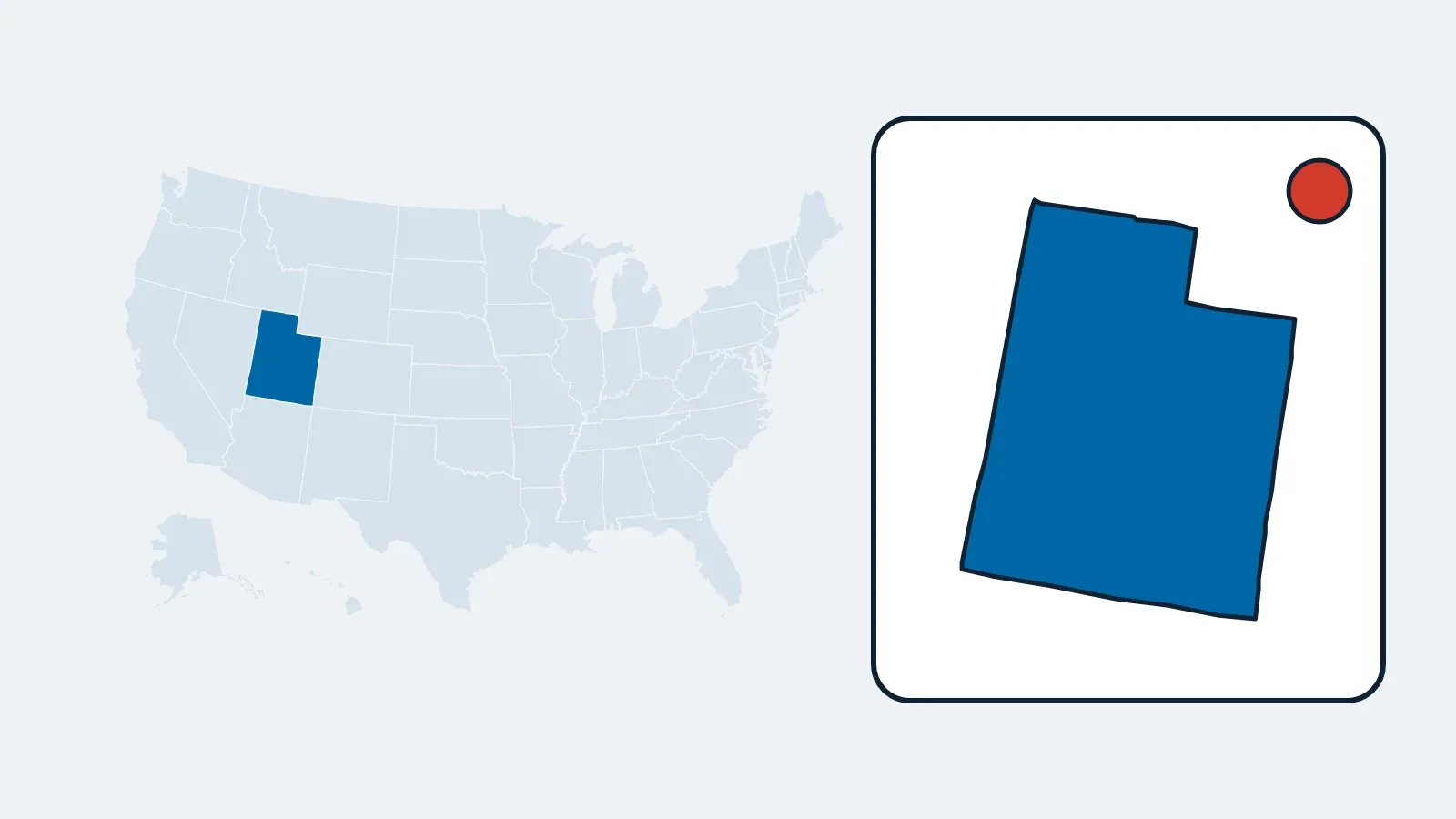
Utah policy rules
State schedule- UM coverage rule
- Reject in writing
- Minimum liability
- 30/65/25 (or $90,000 combined)For policies issued or renewed on or after January 1, 2025; PIP with $3,000 medical is also required
- UM/UIM rule
- UM included unless rejected in writingDefault limits match your liability limits; lower limits need a signed acknowledgment form
- Insurer cancellation notice
- 30 days; 10 days for nonpaymentAfter 60 days, only for nonpayment or grounds the law lists
- Nonrenewal notice
- 30 daysSome single claims and minor tickets cannot be the only reason
- Regulator
- Utah Insurance Department
Minimum limits on a Utah policy
Section 31A-22-304 of the Utah Code sets the floor for Part A. For a policy issued or renewed on or after January 1, 2025, the split limits are $30,000 for one person's injuries, $65,000 for everyone hurt in one accident, and $25,000 for property damage. A single combined limit of $90,000 per accident also meets the law. Policies written before 2025 used 25/65/15 (or $80,000 combined) until their next renewal.
The minimum pays for damage you cause to others, not for your own car. The limits gap worksheet shows how quickly a serious crash can pass these amounts. To prove coverage, Utah Code Section 41-12a-303.2 lets you show your insurance information in electronic form on a mobile device.
Personal injury protection is mandatory
Every Utah policy must include personal injury protection (PIP), which pays your own injury costs no matter who caused the crash. Section 31A-22-307 lists the minimum benefits per person. You cannot drop PIP or take a deductible on these required amounts.
| Benefit | Minimum required |
|---|---|
| Medical expenses | $3,000 per person |
| Lost income | Lesser of $250 a week or 85% of gross income, up to 52 weeks |
| Household services | Up to $20 a day for up to 365 days |
| Funeral, burial or cremation | Up to $1,500 per person |
| Death benefit | $3,000 to the heirs |
The only part you may waive is the lost-income benefit, and only for the named insured and spouse when they sign a statement that neither has earned income from regular work, as the statute describes. See personal injury protection for how the coverage shows on a policy.
Uninsured motorist coverage unless you reject it in writing
Under Section 31A-22-305, a new Utah policy carries uninsured motorist coverage at limits equal to the lesser of your liability limits or the highest UM limits the insurer sells. You have two ways to change that. You can reject UM entirely by an express writing to the insurer, on a form that explains what the coverage is for. Or you can keep it at lower limits by signing an acknowledgment form filed with the Insurance Department that shows the extra premium for higher limits. UM may not be sold below the bodily injury minimums in Section 31A-22-304.
Either choice stays in place until you ask for a change in writing. If you rejected the coverage years ago, your declarations page will show no limit for it. Read Part C before you sign anything.
When a Utah insurer can cancel your policy
Section 31A-21-303 governs cancellation. A new policy that has been in force fewer than 60 days and was never renewed can be cancelled with at least 10 days' notice after delivery. After that point, an insurer may cancel during the term only for nonpayment of premium or one of these grounds:
- A material misrepresentation.
- A substantial change in the risk that the insurer could not reasonably have foreseen.
- A substantial breach of the policy's duties, conditions or warranties.
- Revocation or suspension of the driver's license of the named insured or anyone who customarily drives the car.
For a personal auto policy, a cancellation for nonpayment takes effect no sooner than 10 days after the notice, and a cancellation on other grounds no sooner than 30 days after it. If the notice does not state the facts behind the decision clearly, you can ask in writing, and the insurer must give them within 10 working days. When a financed car's policy ends for nonpayment, the insurer must also tell the lienholder if it has that information. The section sets no refund formula, so your policy's own cancellation terms decide how unearned premium is figured; the cancellation refund worksheet helps you check it.
Renewal and nonrenewal in Utah
Utah gives policyholders a right to renew on the terms the insurer uses for similar risks. An insurer that does not want to renew must send notice at least 30 days before the policy expires. A renewal on less favorable terms or at a higher rate also needs 30 days' notice, with exceptions such as a general rate change for the whole class.
- Read the notice for the reason and the date. If the reason is vague, ask the insurer in writing for the facts.
- Contact the Utah Insurance Department at its toll-free number, (800) 439-3805, if the notice or the reason does not match the rules above.
- Arrange new coverage before the end date. A gap can follow you; see lapse and reinstatement.
Policyholder questions
Can I turn down PIP in Utah?
No. PIP is required on every Utah policy. The only piece that can be waived is the lost-income benefit, for a named insured and spouse with no earned income from regular work, by a written statement.
How do I reject uninsured motorist coverage in Utah?
The named insured signs the insurer's rejection form, which must explain the coverage. Without it, UM stays on the policy at your liability limits. Read Part C first.
Can I show my Utah insurance card on my phone?
Yes. Utah law accepts proof of owner's or operator's security in electronic form on a mobile device.
Sources
- Utah Insurance Department — 10 things to know about buying auto insurance
- Utah Code § 31A-22-304 — Motor vehicle liability policy minimum limits (2025 edition, via Justia)
- Utah Code § 31A-22-305 — Uninsured motorist coverage (2025 edition, via Justia)
- Utah Code § 31A-22-307 — Personal injury protection coverages and benefits (2025 edition, via Justia)
- Utah Code § 31A-21-303 — Cancellation and nonrenewal (2025 edition, via Justia)
- Utah Code § 41-12a-303.2 — Evidence of owner's or operator's security (2025 edition, via Justia)
Facts on this page were checked against these sources on November 15, 2026. Utah raised its minimum liability limits from 25/65/15 to 30/65/25 for policies issued or renewed on or after January 1, 2025.
Request policy quotes
Answer six questions about the policy you need. PolicyBrook passes the request to licensed insurance agents and insurers who can quote it; you compare and decide.
- The policy you need. Cars, drivers, coverage and ZIP.
- Your contact details and consent to be contacted.
- A licensed insurance agent or insurer contacts you with a quote. Nothing is bound until you sign and pay.
PolicyBrook is not paid by you. The licensed insurance agents and insurers who contact you set their own prices and terms. How we make money.
Related readings
-

Policy event
Insurer cancellation
After 60 days, only listed reasons; 10 to 60 days' notice by state, and how to appeal.
-

Endorsement
Personal injury protection
No-fault injury coverage: $10,000 required in Florida, rejectable in Texas, offered in Washington.
-
Policy part
Uninsured motorists (Part C)
Four kinds of uninsured vehicle, who is insured, limits, 60-day trial right after arbitration, state rules.