State: Required
Wisconsin: The Rules Your Auto Policy Must Follow
Wisconsin requires uninsured motorist coverage and medical payments coverage unless you turn the latter down, must tell you that underinsured coverage is available, keeps midterm cancellations to a few grounds, and asks for 60 days' notice before a nonrenewal.
By PolicyBrook Editorial Team Updated 5-minute read
Declarations
Wisconsin- UM/UIM rule
- Required
- Minimum liability
- 25/50/10
- Insurer cancellation notice
- 10 days
- Nonrenewal notice
- 60 days
In brief
A Wisconsin policy must carry at least $25,000/$50,000/$10,000 of liability coverage and uninsured motorist coverage of at least $25,000/$50,000. Medical payments coverage of at least $1,000 is included unless the named insured rejects it, and the insurer must tell you that underinsured motorist coverage is available. After 60 days, an insurer can cancel only for nonpayment or limited grounds, with at least 10 days' notice, and it must give 60 days' notice before it refuses to renew. The Office of the Commissioner of Insurance (OCI) enforces these rules.
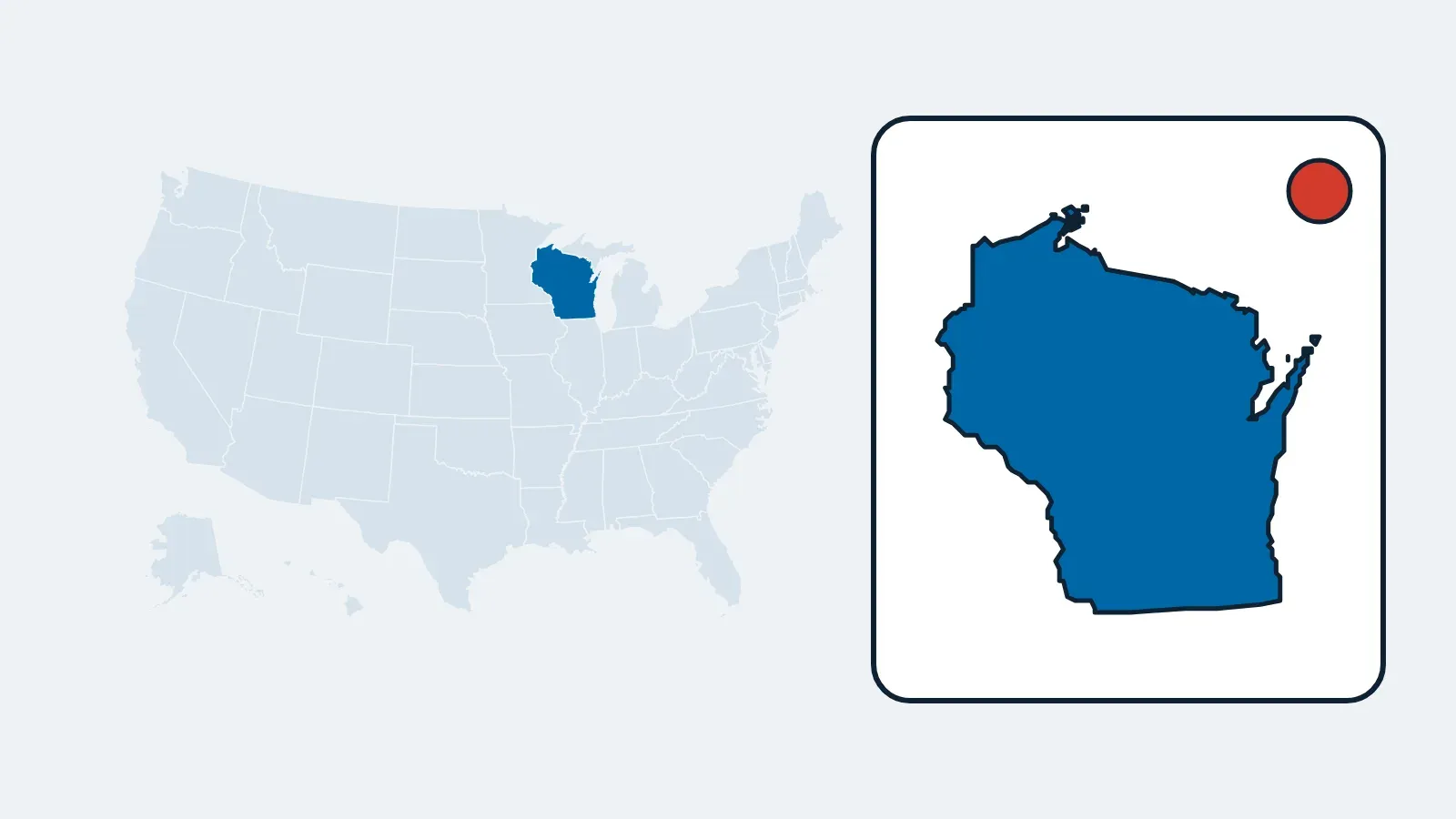
Wisconsin policy rules
State schedule- UM coverage rule
- Required
- Minimum liability
- 25/50/10
- UM/UIM rule
- UM required, 25/50 minimumUIM optional after a written notice; medical payments included unless rejected
- Insurer cancellation notice
- 10 daysAfter 60 days, only for nonpayment or limited grounds stated in the policy
- Nonrenewal notice
- 60 daysLate notice means coverage continues on the old terms for up to a year
- Regulator
- Wisconsin Office of the Commissioner of Insurance (OCI)
Minimum limits and proof in Wisconsin
OCI's auto insurance FAQ lists the mandatory liability limits as $25,000 for injury or death of one person, $50,000 for two or more people, and $10,000 for property damage. Those are the amounts on a minimum declarations page. The limits gap worksheet shows what could be left over after a bigger crash.
You must carry proof of coverage and show it when a traffic officer asks. The Wisconsin Legislative Council's 2024 issue brief explains that the proof may be printed or electronic, citing Section 344.62 of the statutes.
UM, medical payments and the UIM notice
Section 632.32(4) of the Wisconsin Statutes lists the coverages every policy on a car registered or garaged in Wisconsin must contain. Section 632.32(4m) adds a notice duty for underinsured motorist coverage.
| Coverage | Rule | Minimum |
|---|---|---|
| Uninsured motorist | Required on every policy | $25,000 per person, $50,000 per accident |
| Medical payments | Included unless a named insured rejects it | $1,000 per person |
| Underinsured motorist | Insurer must give written notice that it is available | $50,000 per person, $100,000 per accident if you buy it |
The statute has no rejection process for uninsured motorist coverage. For underinsured coverage, you do not have to sign anything: not paying the premium for it counts as a rejection, and the insurer need not offer it again at renewal unless someone asks in writing. A medical payments rejection likewise carries to renewals until a named insured asks for the coverage in writing. See Part C and Part B for what each pays.
When a Wisconsin insurer can cancel your policy
Section 631.36(2) governs midterm cancellation. A new policy that has never been renewed and has been in effect fewer than 60 days can be cancelled for any reason, with at least 10 days' written notice. After that, the insurer can cancel during the term only for nonpayment, or for grounds written into the policy that fall into one of these classes:
- A material misrepresentation.
- A substantial change in the risk that the insurer could not reasonably have foreseen.
- A substantial breach of the policy's duties, conditions or warranties.
Every such cancellation takes effect no sooner than 10 days after the notice is mailed first class or delivered to you. OCI notes that auto policies generally have no grace period, so a missed payment can start this clock quickly. OCI also says an insurer may not cancel, refuse or nonrenew an auto policy because of your age, sex, residence, race, marital status or occupation, among other listed traits.
Note the phrase "stated in the policy": outside nonpayment, the insurer can rely only on cancellation grounds that its own policy form spells out, and those grounds must fit the classes above. Look for them in the termination provisions of Part F. Neither the midterm cancellation subsection nor OCI's fact sheet sets a refund method, so your policy decides how unearned premium comes back; the cancellation refund worksheet helps you estimate it.
Renewal and nonrenewal in Wisconsin
OCI's fact sheet on terminations says an insurer must mail or deliver a nonrenewal notice at least 60 days before the policy expires, state the reason, and explain how to apply to the Wisconsin Automobile Insurance Plan. If the notice is late, the insurer must keep you covered on the old terms and premium for the policy term or one year, whichever is shorter.
- Ask the insurer or agent first for the reason and any way to keep the policy.
- Contact OCI at 1-800-236-8517 or through its online complaint form if the notice or reason looks wrong.
- Arrange new coverage before the end date. See nonrenewal for the order of steps.
Policyholder questions
Can I reject uninsured motorist coverage in Wisconsin?
No. Uninsured motorist coverage of at least $25,000/$50,000 is required on every policy. Underinsured motorist coverage is the optional one.
How much notice does a Wisconsin insurer give before cancelling?
At least 10 days. After the first 60 days, only nonpayment or a misrepresentation, a substantial change in risk or a substantial breach allows a midterm cancellation.
How far ahead must a Wisconsin insurer warn me it will not renew?
At least 60 days before the policy expires, with the reason. A late notice means the insurer must continue the policy on its old terms for up to a year.
Sources
- Wisconsin Statutes § 631.36(2) — Midterm cancellation
- Wisconsin Statutes § 632.32(4) and (4m) — Required uninsured motorist and medical payments coverage; UIM notice
- Wisconsin OCI — Frequently asked questions: automobile insurance (updated August 3, 2026)
- Wisconsin OCI — Fact sheet on insurance terminations, denials and cancellations (updated March 5, 2026)
- Wisconsin Legislative Council — Issue brief: motor vehicle liability insurance (April 2024)
Facts on this page were checked against these sources on November 15, 2026. The 60-day nonrenewal notice and the 45-day renewal-change notice are taken from OCI's fact sheet on terminations, updated March 5, 2026.
Request policy quotes
Answer six questions about the policy you need. PolicyBrook passes the request to licensed insurance agents and insurers who can quote it; you compare and decide.
- The policy you need. Cars, drivers, coverage and ZIP.
- Your contact details and consent to be contacted.
- A licensed insurance agent or insurer contacts you with a quote. Nothing is bound until you sign and pay.
PolicyBrook is not paid by you. The licensed insurance agents and insurers who contact you set their own prices and terms. How we make money.
Related readings
-

Policy event
Insurer cancellation
After 60 days, only listed reasons; 10 to 60 days' notice by state, and how to appeal.
-
Policy event
Nonrenewal
Notice periods from 15 to 75 days, reasons states bar, and how to ask the regulator for review.
-
Policy part
Uninsured motorists (Part C)
Four kinds of uninsured vehicle, who is insured, limits, 60-day trial right after arbitration, state rules.