State: Reject in writing
Montana: The Rules Your Auto Policy Must Follow
Montana sets the minimum limits, puts uninsured motorist coverage on every policy unless you decline it, and requires 45 days' notice before an insurer cancels for most reasons or refuses to renew. Here is what that means for your policy.
By PolicyBrook Editorial Team Updated 5-minute read
Declarations
Montana- UM/UIM rule
- Reject in writing
- Minimum liability
- 25/50/20
- Insurer cancellation notice
- 45 days (10 nonpayment)
- Nonrenewal notice
- 45 days
In brief
A Montana policy must carry at least $25,000/$50,000/$20,000 of liability coverage. Uninsured motorist coverage must be included unless the named insured rejects it; the state's insurance regulator says that takes a signed form. After 60 days in force, an insurer can cancel only for nonpayment or a suspended or revoked license or registration, with 45 days' notice (10 for nonpayment), and it must give 45 days' notice before it refuses to renew. The Montana Commissioner of Securities and Insurance (CSI) enforces these rules.
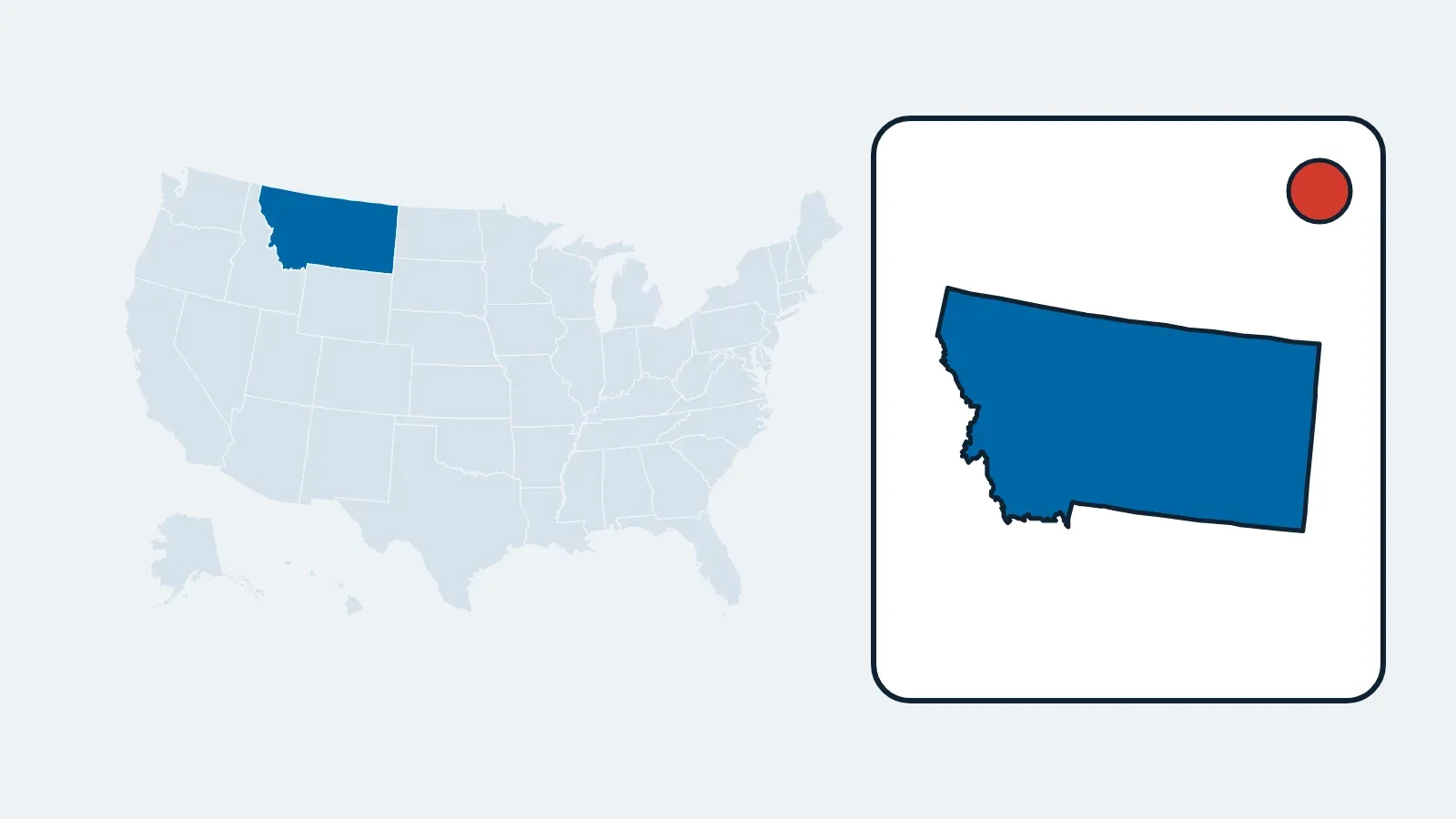
Montana policy rules
State schedule- UM coverage rule
- Reject in writing
- Minimum liability
- 25/50/20
- UM/UIM rule
- Included unless the named insured rejects it on a signed formThe statute grants the right to reject; CSI describes a signed form
- Insurer cancellation notice
- 45 days; 10 days for nonpaymentAfter 60 days, only for nonpayment or a license or registration suspension or revocation
- Nonrenewal notice
- 45 daysWithout proper notice, the insurer must renew
- Regulator
- Montana Commissioner of Securities and Insurance (CSI)
Minimum limits and proof of insurance
Section 61-6-103 of the Montana Code Annotated requires liability limits of at least $25,000 for injury to one person, $50,000 for injuries to two or more people in one accident, and $20,000 for damage to others' property, written 25/50/20. The limits gap worksheet shows how quickly a serious crash can pass those amounts.
You can carry proof on a phone. Section 61-6-302 accepts an electronic device showing an electronic document issued by your insurer, and you must show it when an officer or judge asks.
Uninsured motorist coverage unless you reject it
Under section 33-23-201, an insurer may not issue a liability policy for a car registered and principally garaged in Montana unless it includes uninsured motorist coverage at the 61-6-103 limits. The named insured has the right to reject it. The statute does not set the form of rejection, but CSI's consumer page says the coverage must be offered unless you sign a form declining it.
A rejection carries forward: on a renewal with the same insurer, the coverage does not return unless the named insured asks for it in writing. If your declarations page shows no uninsured motorist limit, check whether a rejection was signed, and read Part C for what the coverage pays.
When a Montana insurer can cancel your policy
Section 33-23-211 protects a policy that has been in force 60 days or more when the notice goes out, and any renewal policy. Those policies can be cancelled only for:
- Nonpayment of premium.
- Suspension or revocation of the driver's license or vehicle registration of the named insured, or of another driver who lives in the household or regularly drives an insured car, during the policy period (for a renewal, also the 180 days before it began).
Section 33-23-212 sets the notice. For nonpayment, the insurer must give at least 10 days' notice with the reason. For any other reason, the notice must be mailed or delivered to the address on the policy at least 45 days before the cancellation date. If the reason is not stated, the notice must say you can get it by a written request sent at least 21 days before that date.
When an insurer cancels for nonpayment, section 33-23-217 requires a pro rata calculation and the return of the full gross unearned premium. Use the cancellation refund worksheet to estimate it.
Renewal and nonrenewal in Montana
Section 33-23-214 requires at least 45 days' notice before an insurer refuses to renew. The notice must tell you that you can ask for the reasons in writing; you have one month after the policy ends to ask, and the insurer must answer within 15 days. If the insurer does not give proper notice, it must renew the policy, though the old policy still ends when a replacement policy you buy for the same car takes effect.
The notice rule does not apply when the premium or an installment is unpaid, when the insurer has offered to renew, or when your agent placed other coverage at least 20 days before the end date. For a policy with a term under six months, nonrenewal is allowed only for the same reasons that permit cancellation.
Where to ask and complain
- Request the reason in writing within the deadline printed on your cancellation or nonrenewal notice.
- Call CSI's consumer advocates at 800-332-6148 or 406-444-2040 with questions.
- File a complaint in writing or online at csimt.gov; CSI will ask the insurer to review its decision.
Policyholder questions
How much notice must a Montana insurer give before cancelling my car insurance?
At least 45 days for any reason other than nonpayment, and at least 10 days for nonpayment. After 60 days in force, only nonpayment or a license or registration suspension or revocation qualify.
How do I reject uninsured motorist coverage in Montana?
The named insured declines it; CSI says that means signing a rejection form. Without one, the coverage is on the policy. Read Part C before you sign.
Can I show my Montana insurance card on my phone?
Yes. Montana law accepts an electronic document from your insurer shown on an electronic device, and you must display it when asked.
Sources
- Montana Code Annotated, Section 33-23-201 — Uninsured motorist coverage and rejection
- Montana Code Annotated, Section 33-23-211 — Limits on cancellation
- Montana Code Annotated, Section 33-23-212 — Notice of cancellation
- Montana Code Annotated, Section 33-23-214 — Notice of nonrenewal
- Montana Code Annotated, Section 33-23-217 — Return of unearned premium
- Montana Code Annotated, Section 61-6-103 — Minimum liability limits
- Montana Code Annotated, Section 61-6-302 — Proof of insurance, including electronic documents
- Montana Commissioner of Securities and Insurance — Auto insurance
Facts on this page were checked against these sources on November 15, 2026. Montana uses the same 45-day notice for nonrenewal and for cancellation for any reason other than nonpayment.
Request policy quotes
Answer six questions about the policy you need. PolicyBrook passes the request to licensed insurance agents and insurers who can quote it; you compare and decide.
- The policy you need. Cars, drivers, coverage and ZIP.
- Your contact details and consent to be contacted.
- A licensed insurance agent or insurer contacts you with a quote. Nothing is bound until you sign and pay.
PolicyBrook is not paid by you. The licensed insurance agents and insurers who contact you set their own prices and terms. How we make money.
Related readings
-
Policy event
Nonrenewal
Notice periods from 15 to 75 days, reasons states bar, and how to ask the regulator for review.
-

Policy event
Insurer cancellation
After 60 days, only listed reasons; 10 to 60 days' notice by state, and how to appeal.
-

Policy part
Uninsured motorists (Part C)
Four kinds of uninsured vehicle, who is insured, limits, 60-day trial right after arbitration, state rules.